
Jersey Village Clay Soil: How It Damages Concrete
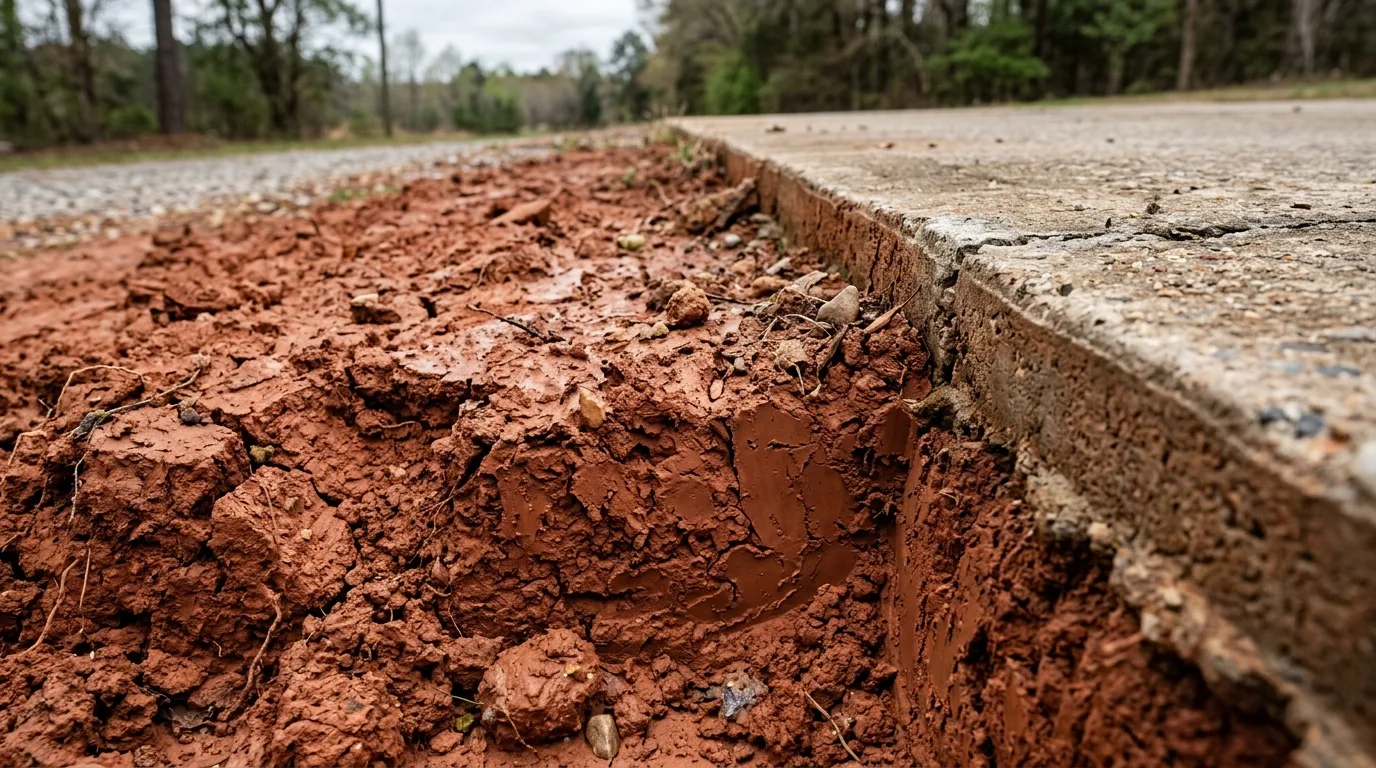
Your concrete driveway was perfectly smooth when it was poured. Five years later, it has cracks running across it and one section has sunk a half-inch below the other. You haven’t done anything to it. What happened? In Jersey Village, the answer is almost always the same: Black Gumbo clay soil. In this post, we cover what makes Jersey Village’s soil different, how it damages concrete over time, and what proper installation and repair look like when you account for the soil conditions that most contractors don’t discuss.
Concrete Problems in Jersey Village? Get an Honest Assessment
We identify root causes — not just surface symptoms. Free evaluations from Jersey Village Concrete.
Why Jersey Village’s Clay Soil Matters for Concrete
Jersey Village sits on one of the most expansive clay soils in the United States. Black Gumbo clay — the dominant soil type in Harris County and throughout the Steeplechase and Fairbanks neighborhoods of Jersey Village — has a shrink-swell potential that structural engineers rank among the highest in the Texas Gulf Coast region. The clay absorbs water readily, expanding in volume by 10–15% during wet periods. When the soil dries, it contracts by a similar amount, pulling away from whatever rests on it — including your concrete driveway, patio, or foundation slab.
This isn’t a problem that affects every property equally. The degree of movement depends on the clay depth, the proximity of trees (whose roots extract moisture unevenly, creating differential soil movement), and the quality of drainage around the concrete. Properties near Jersey Lake or in the low-lying areas of the Carverdale Border zone tend to experience more pronounced clay movement than properties on higher ground. But no Jersey Village property is immune — the clay is present everywhere.
The seasonal timing of Houston’s rainfall amplifies the problem. June and July typically deliver 6–7 inches of rain to Jersey Village — the wettest months of the year. The clay absorbs that water and swells, pushing upward against the concrete slab from below. By October and November, the drier weather has allowed the clay to partially contract. The slab that was pushed up in summer is now partially unsupported in fall. Concrete can handle compression but cracks under tension, so the unsupported sections develop fractures at their weakest points — usually at control joints that weren’t cut deep enough, or at the edges of the slab.
Types of Concrete Damage Caused by Clay Soil
Settlement cracking: One section of concrete has sunk relative to adjacent sections, creating a visible lip or step at the joint between them. This happens when the clay beneath the slab contracts more in one area than another — a common outcome of uneven shade, tree root activity, or differential drainage across the slab footprint.
Heave cracking: The opposite pattern — one section has been pushed upward. Interior slab sections tend to heave more than exterior edges because trees and foundation drainage concentrate soil moisture differently across the footprint. Heave cracking creates a dome or hump in the concrete that’s a trip hazard and a sign of active soil pressure.
Random surface cracking: A network of cracks across the slab surface, often creating an irregular polygon pattern. This type develops when the slab has been cyclically stressed by repeated soil movement over several years, causing fatigue cracking through the depth of the concrete.
Foundation separation: The gap between an exterior concrete slab (patio, driveway) and the home’s foundation grows as soil movement works the two structures apart. Water infiltrates the gap, accelerating clay swelling at the foundation edge.
Practical Uses: How to Manage Clay Soil on Your Property
- New concrete installation: Always specify a 4–6 inch compacted crushed limestone base before the pour. This is the single most effective intervention for Black Gumbo clay sites and prevents clay movement from reaching the concrete slab above it. In severe cases, lime stabilization of the native clay subgrade adds additional protection.
- Foundation maintenance: Maintain consistent soil moisture around your home’s foundation year-round — allow the clay to stay slightly moist even in dry periods to reduce the amplitude of seasonal swelling and shrinkage. Soaker hoses along the foundation perimeter are a common approach for Jersey Village homeowners.
- Drainage design: Direct all roof runoff, downspouts, and surface water at least 6 feet away from concrete slabs. Water that pools against or beneath a concrete driveway in the Steeplechase neighborhood — or anywhere in Jersey Village — is directly feeding the clay movement that will eventually crack the slab.
- Tree selection and placement: Large trees with aggressive root systems — live oaks, pecans, cottonwoods — planted near driveways or foundation slabs extract soil moisture in patterns that create differential settlement. If you’re planning new concrete, consider tree proximity in your drainage design.
- Monitoring existing concrete: Mark crack endpoints with paint to track whether cracks are growing. Cracks that grow between wet and dry seasons are actively caused by clay movement and need a drainage solution, not just a surface fill.
How It Works: The Damage Cycle in Jersey Village
The concrete damage cycle in Jersey Village follows a predictable pattern. During Houston’s wet season (June–September), Black Gumbo clay absorbs water and swells. This upward pressure — called heave force — is distributed unevenly across the slab because moisture doesn’t penetrate the clay uniformly. Where swelling is greater, the concrete is pushed up; where it’s lesser, the slab stays at its original elevation. This differential creates tension in the concrete that exceeds its tensile strength, initiating cracking at the weakest points.
Jersey Village Concrete Repair That Addresses Root Causes
We assess soil movement and drainage before recommending any repair. Call (888) 376-0955.
Cost Factors for Clay Soil Concrete Repair
Addressing clay soil-related concrete damage in Jersey Village involves cost at two levels. Surface repair — crack filling and patching — runs $3–$7 per linear foot and addresses the symptom without the cause. This is appropriate for minor cracks where the underlying drainage and soil conditions have been corrected separately. Drainage correction, which is the critical component, typically costs $500–$2,500 depending on the scope — regrading soil away from the structure, extending downspouts, or installing a French drain system.
When the damage has progressed to slab sections that have settled or heaved, slab lifting via polyurethane foam injection typically costs $1,500–$5,000 and is far less disruptive than breaking out and replacing the concrete. Full slab replacement, necessary when cracking is widespread through the full slab depth, runs $6–$14 per square foot — comparable to new concrete driveway installation in Jersey Village’s market. The earlier the damage is caught and the root cause addressed, the lower the total cost.
Frequently Asked Questions
How do I know if my concrete damage is caused by clay soil movement?
The clearest indicator is seasonal pattern. If cracks open up or get wider during Houston’s summer rains and appear to narrow or stabilize during dry months, clay movement is actively involved. Settlement (one section sinking relative to another) and heave (one section pushing up) are also strong indicators of differential soil movement beneath the slab. A concrete contractor experienced with Harris County soil conditions can assess your specific situation.
Can I repair clay soil damage without addressing the drainage?
Surface repairs without drainage correction are temporary solutions in Jersey Village. The clay that caused the original cracking will continue its seasonal movement cycle — a crack fill applied over an active drainage problem typically re-opens within 1–3 years. Addressing drainage and soil moisture before or alongside the concrete repair is the only approach that produces lasting results.
Does lime stabilization really work for Black Gumbo clay?
Yes. Lime reacts chemically with the clay to reduce its plasticity and shrink-swell potential, creating a more stable subgrade that doesn’t participate as dramatically in moisture cycling. TxDOT uses lime stabilization routinely on Texas highway projects for exactly this reason. For residential applications in Jersey Village, lime stabilization is most justified on sites with particularly deep clay or active drainage problems where even a thick crushed limestone base provides insufficient isolation.
Protect Your Jersey Village Concrete From Clay Soil Damage
Call Jersey Village Concrete at (888) 376-0955 for an honest assessment and repair plan that addresses root causes.
Related: