
Jersey Village Concrete Slab Foundations: What to Know
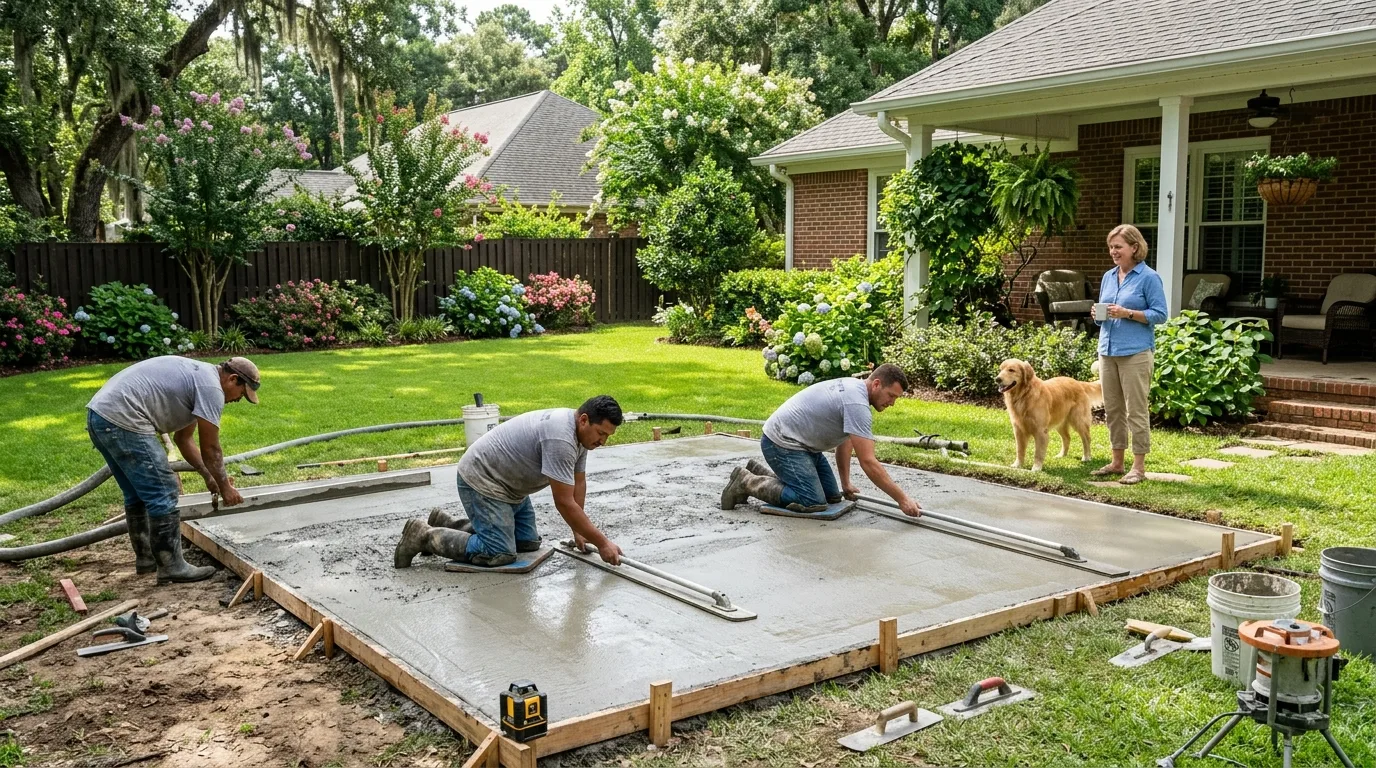
Nearly every home in Jersey Village sits on a concrete slab foundation — the standard construction method throughout Harris County and the Houston Gulf Coast area. Unlike basement or crawl space foundations common in the Northeast, slab foundations pour directly on the prepared grade and carry the entire structural load of the home through that concrete platform to the soil below. In Jersey Village, that soil is Black Gumbo clay, and the relationship between the concrete slab and the clay beneath it is the central engineering challenge of residential construction here. In this post, we cover how slab foundations are built in Jersey Village, what the expansive clay means for slab behavior, and what homeowners should monitor and maintain to protect their foundation investment.
Slab Foundation Questions in Jersey Village? Get an Honest Answer
Jersey Village Concrete assesses slab conditions and recommends practical solutions. Call (888) 376-0955.
Why Slab Foundations Behave Differently in Jersey Village
Slab foundations in Jersey Village experience something that engineers call differential movement — the slab doesn’t move uniformly as the soil beneath it changes. The exterior edges of the slab, which are in direct contact with the exterior environment, experience more dramatic soil moisture changes than the interior because exterior soil dries out faster in summer and gets wetter faster in rain events. This differential creates the classic Jersey Village foundation problem: the interior of the slab has stayed relatively stable over the decades, while the exterior edges have risen (heaved from wet-season clay swelling) and fallen (settled from dry-season clay contraction) in varying amounts each year.
The cumulative effect of this annual cycling is a slab that is no longer planar — the interior is often slightly higher than the perimeter in homes where exterior drainage has been directing water away from the foundation, or slightly lower in homes where drainage has been concentrating water at the foundation edge. Neither condition is inherently catastrophic, but both create stresses in the structural frame above the slab that manifest as the door sticking, wall cracking, and tile popping symptoms that Jersey Village homeowners are familiar with.
Types of Slab Foundation Construction in Jersey Village
Post-tensioned slab: The modern standard for residential construction in the Houston area since the 1980s. A grid of steel cables (tendons) is placed in the slab forms before the pour, then tensioned after the concrete cures using hydraulic jacks. The tensioned cables put the concrete in compression, which is concrete’s strongest state — the slab resists cracking and differential movement better than a conventionally reinforced slab of the same thickness. Post-tensioned slabs typically use less concrete (thinner slab) than conventional reinforcement for equivalent performance.
Conventionally reinforced slab: Rebar or wire mesh placed in the forms before the pour. Still appropriate for outbuildings, garage slabs, and additions but less common in new main-building construction in Harris County since post-tensioning became standard. More susceptible to cracking under differential movement than post-tensioned slabs, which is why the age of a home is relevant to its foundation behavior in Jersey Village.
Stiffened slab (ribbed): A slab with concrete beams (ribs or grade beams) cast into the underside at regular intervals. The beams extend down into the clay, creating a deeper bearing surface that’s less susceptible to surface clay movement. This is the TXDoT-influenced design approach that structural engineers often recommend for new construction on highly active clay sites in Harris County.
Practical Uses: What Homeowners Should Monitor
- Interior door behavior: Track which doors stick and in which season. A door that sticks in wet months and frees up in dry months is a reliable indicator of active clay swelling beneath that area of the slab. Map the stuck-door locations — a pattern of sticking along one wall identifies which section of the foundation is most active.
- Floor tile and grout: Walk barefoot across tile floors annually. Any tile that sounds hollow (tap it — a hollow sound vs. a solid thud), or any tile that has cracked, indicates loss of bond between the tile and the slab. This often occurs near areas of maximum differential movement.
- Exterior concrete separation: Check the gap between any exterior concrete slab (patio, driveway, walkway) and the home foundation at least annually. A growing gap is a sign of differential movement between the home slab and the adjacent concrete — photograph and date the gap to track its progress.
- Drainage audit: Walk the perimeter of your home during or immediately after a heavy rain (Jersey Village gets 6–7 inches in June and July). Water that pools against the foundation is feeding clay swelling at exactly the point you want to keep dry.
- Baseline measurements: Ask a foundation contractor to take elevation measurements of your floor at multiple points. These baseline measurements make future movement easy to quantify — instead of estimating that something “seems off,” you have actual data.
How It Works: Slab Foundation Construction in Jersey Village
New construction slab foundations in Jersey Village follow a specific sequence. After the lot is graded, the slab perimeter and interior beams are laid out and excavated. A moisture barrier (polyethylene vapor barrier) is placed over the prepared subgrade to reduce upward moisture migration from the clay into the concrete. Base material — typically a few inches of crushed granite or similar coarse aggregate — is placed and compacted over the vapor barrier.
Jersey Village Concrete Slab Consultation and Repair
We assess, stabilize, and repair concrete slabs throughout Harris County. Call (888) 376-0955.
Cost Factors for Slab Foundation Work in Jersey Village
New concrete slab installation in Jersey Village for a garage, addition, or outbuilding runs $5–$10 per square foot for standard 4-inch residential slabs, or $8–$14 per square foot for post-tensioned or heavily reinforced slabs designed for structural loads. For an existing home foundation, the relevant costs are:
Foundation assessment: $300–$600 for a professional engineer’s report with elevation measurements and repair recommendations. Worth the cost before committing to any repair approach.
Drainage correction: $500–$3,000 depending on scope — regrading, downspout extension, French drain installation. The most cost-effective foundation maintenance investment in Jersey Village given that drainage is the root cause of most foundation movement.
Slab lifting: $1,500–$5,000 for polyurethane foam injection beneath settled sections. Less disruptive and faster than full slab removal, appropriate for moderate settlement.
Pier installation: $5,000–$15,000+ for steel pier installation to stabilize significantly settled sections. The most involved repair option but appropriate when settlement has exceeded what slab lifting can address.
Frequently Asked Questions
How do I know if my Jersey Village slab foundation needs repair?
The most reliable indicators are differential interior door behavior (sticking correlates with wet season, freeing up in dry season), visible floor cracks with differential elevation, and growing gaps between the exterior of the home and adjacent concrete. Any single indicator warrants monitoring; two or more indicators warrant a professional evaluation. See our detailed guide on 5 signs your Jersey Village foundation needs repair for a full diagnostic framework.
What causes slab foundations to fail in Harris County?
The primary cause is drainage failure — water that concentrates near the foundation edge feeds the seasonal swelling and contraction of the Black Gumbo clay beneath the slab. Secondary causes include inadequate original construction (missing vapor barrier, insufficient base material, no post-tensioning) and tree roots that extract soil moisture unevenly around the slab perimeter. The clay soil itself is the constant; drainage management is the controllable variable that determines how much that clay moves.
Should I maintain a consistent soil moisture level around my foundation?
Yes — this is one of the most effective foundation maintenance strategies for Jersey Village homes. The goal is to prevent the extreme dry-out that causes maximum clay contraction adjacent to the foundation. A soaker hose system set on a timer during extended dry spells — common in Jersey Village in September and October — maintains a consistent soil moisture level at the foundation perimeter that reduces the amplitude of clay movement. This approach is recommended by structural engineers who work regularly in Harris County.
Jersey Village Concrete Slab Foundations — Assessment and Repair
Call Jersey Village Concrete at (888) 376-0955 for an honest assessment of your slab's condition.
Related: