
Jersey Village Commercial Concrete: Business Owner's Guide
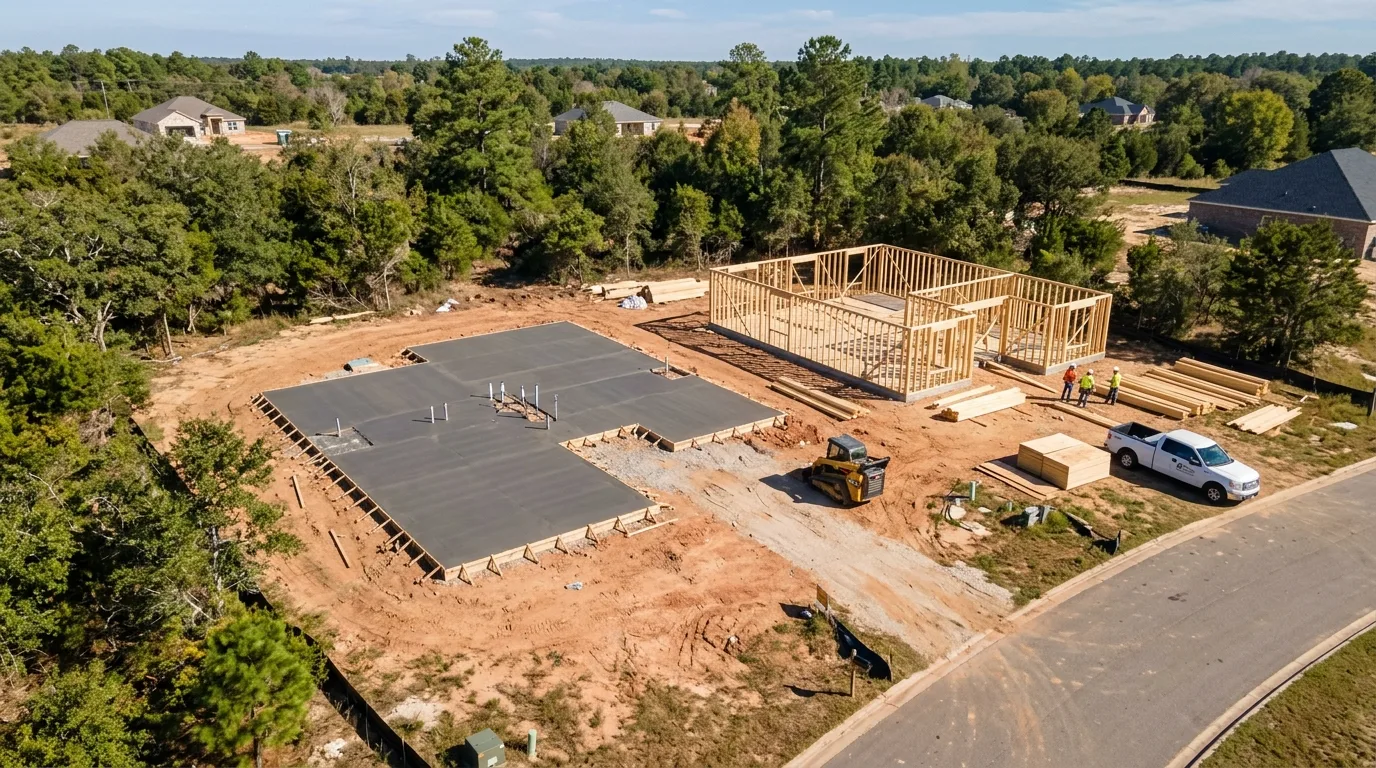
A deteriorating parking lot is one of the first things customers notice about a business — and one of the last things business owners plan for in their capital budget. In Jersey Village, where the Jones Road Corridor and US Highway 290 commercial zones support a dense mix of light industrial, office, and retail businesses, concrete parking lots and commercial slabs are among the most significant infrastructure investments a business owner makes. Getting the concrete right the first time — proper thickness, correct reinforcement, Harris County clay soil management, and full permit compliance — costs more upfront but eliminates the cycle of patchwork repair that plagues commercial properties built to minimum standards. This post covers what Jersey Village business owners need to know about commercial concrete in 2026.
Commercial Concrete Proposal for Your Jersey Village Business
We provide detailed, itemized proposals for commercial concrete projects. Call (888) 376-0955.
Why Commercial Concrete Differs from Residential in Jersey Village
Commercial concrete in Jersey Village is fundamentally different from residential work in three dimensions. First, loads: a commercial parking lot handles delivery vehicles, box trucks, and high-frequency traffic patterns that residential driveways never see. Standard residential concrete (4-inch, wire mesh) fails under commercial loads within a few years. Commercial concrete requires 6-inch minimum thickness with a rebar grid at 18-inch centers — specifications that cost more but are the only appropriate solution for vehicle loads in a commercial application.
Second, permitting: commercial construction in Jersey Village involves a more complex permit process than residential work, often requiring engineering drawings and more rigorous plan review. The City of Jersey Village’s Vertex Plans portal handles commercial permits, but the documentation requirements are more extensive. Third, business continuity: a commercial concrete project that shuts down parking for two weeks costs a business in customer access and revenue. Phasing, sequencing, and minimizing disruption are management skills that residential contractors don’t typically need.
Types of Commercial Concrete Projects in Jersey Village
Parking lots: The most common commercial concrete project in Jersey Village. Parking lot concrete for light to medium commercial use is typically specified at 6 inches with a #4 rebar grid at 18-inch centers and compacted base. For heavy truck or delivery vehicle areas, 7–8 inch thickness with heavier reinforcement is appropriate.
Loading docks and truck aprons: Repeated heavy loads from delivery vehicles require the highest specification — typically 8-inch concrete or thicker with closely spaced rebar. These areas also need specific drainage design to prevent water accumulation under the dock approach.
Commercial slab foundations: New commercial buildings in the Jersey Village City Center and along Beltway 8 area require engineered slab foundations that account for Harris County’s clay soil. These are designed to specific engineering specifications rather than rule-of-thumb contractor guidelines.
Curb and gutter: Concrete curb and gutter systems define parking lot flow, protect landscaping, and direct drainage. Properly poured curb and gutter also qualifies for ADA-compliant curb cut design where required.
Sidewalk and ADA ramp: Commercial properties must maintain accessible pedestrian routes. Concrete sidewalks and ADA-compliant curb ramps are required on any commercial project that modifies the pedestrian infrastructure adjacent to the property.
Practical Uses: What Jersey Village Businesses Need
- Retail businesses on Jones Road Corridor: Customer-facing parking lots are curb appeal infrastructure. A cracked, faded parking lot signals deferred maintenance to customers. Commercial-grade concrete installed correctly runs 20–30 years without major intervention.
- Light industrial along US-290: Truck aprons and loading areas must handle repeated heavy vehicle loads. The difference between 6-inch and 8-inch concrete with rebar — a cost difference of perhaps $2–$3 per square foot — is the difference between a 5-year repair cycle and a 20-year service life.
- Office buildings near Beltway 8: Lower traffic volumes allow standard 6-inch commercial specification, but drainage design is critical — parking lot water that doesn’t drain away from the structure accelerates clay movement at the building foundation.
- TIRZ and Chapter 380 redevelopment projects: Development incentive projects in Jersey Village’s commercial corridors often specify minimum infrastructure quality requirements. Commercial concrete that meets city standards from the outset avoids compliance issues that can complicate incentive disbursements.
- Quick-service restaurants and gas stations: High-turnover commercial uses with fuel infiltration risk benefit from concrete over asphalt — fuel spills soften and degrade asphalt permanently, but concrete handles petroleum exposure without structural degradation.
How It Works: Commercial Concrete Project Management
Commercial concrete in Jersey Village follows a more formal project management process than residential work. The sequence: site assessment and existing conditions documentation, proposal with detailed engineering specifications, permit application through Vertex Plans with required engineering drawings, phasing plan for occupied sites, material procurement and scheduling with the batch plant, base preparation and reinforcement placement, pour day coordination (often requiring multiple concrete trucks and a pump truck for large pours), finishing and joint cutting within the critical 24-hour window, and inspection scheduling through the Vertex Plans portal.
Jersey Village Commercial Concrete — Managed Start to Finish
From permit to pour to final inspection. Call Jersey Village Concrete at (888) 376-0955.
Cost Factors for Commercial Concrete in Jersey Village
Standard commercial concrete parking lots in Jersey Village run $6–$12 per square foot installed. This range reflects:
Concrete thickness: Standard 6-inch for light commercial, 7–8 inch for heavy vehicle areas. Each additional inch adds approximately $1–$2 per square foot in material and placement cost.
Reinforcement: #4 rebar at 18-inch centers is standard for 6-inch commercial concrete. Heavier reinforcement for higher loads adds $0.50–$1.50 per square foot.
Base preparation: Harris County’s clay soil requires 6-inch compacted crushed limestone base for commercial applications — more extensive than residential. Sites with particularly active clay may require lime stabilization of the native subgrade, adding $1–$2 per square foot.
Project size: Large projects (50,000+ sq ft) benefit from volume pricing on concrete material delivery and more efficient pour logistics. Small commercial projects have higher per-square-foot costs because fixed project overhead (mobilization, equipment, permit) is spread over fewer square feet.
Drainage infrastructure: Trench drains, inlet boxes, and piped drainage add cost but are necessary for parking lot drainage compliance in Harris County’s rainfall environment.
Frequently Asked Questions
How long does commercial concrete installation take in Jersey Village?
A typical Jersey Village commercial parking lot (20,000–40,000 sq ft) takes 3–6 weeks from mobilization to completion, including site preparation, base work, phased pours, and curing. The phased pour approach allows sections to be placed independently while others are still in the base preparation stage, reducing overall timeline. Permit review through the Vertex Plans portal adds 1–4 weeks to project start depending on engineering review complexity. We schedule pre-construction meetings with business owners to align on phasing that minimizes disruption to operations.
What permits does commercial concrete work require in Jersey Village?
All commercial construction in Jersey Village requires permits through the Vertex Plans portal. Commercial paving permits require an insurance certificate naming the City of Jersey Village as an additional insured, and any work in the public right-of-way requires a $15,000 surety bond. Engineering drawings are typically required for commercial projects — simple parking lots may require a grading and drainage plan; structural slabs require engineering-stamped drawings. We manage the full permit process including engineering coordination.
Can Jersey Village businesses finance commercial concrete improvements?
We don’t offer financing directly, but many commercial concrete improvements qualify for SBA equipment or improvement loans, commercial real estate improvement loans from banks, or in some cases, TIRZ infrastructure grants for properties in Jersey Village’s designated redevelopment zones. We can provide the detailed project documentation (scope, specifications, cost breakdown) that lenders and grant programs typically require.
Commercial Concrete That Works for Jersey Village Businesses
Call Jersey Village Concrete at (888) 376-0955 for a commercial proposal. Permitted, phased, and professionally managed.
Related: